Wednesday, June 06, 2012

Kranj. Slovene origins, Slovakian myths: Carantania. The Flood


How the earth was created, by whom, what elements of life are to be valued and pursued, are part of any culture's traditions.  In Slovenia, the contemporary Austrian "look" of the country, from its long association with the old Austro-Hungarian Empire, and its medieval castles and the peasants' revolts that surged also elsewhere, distract from older traditions.  Go beyond Jason and the Golden Fleece, to origins.

A good source site is http://www.thezaurus.com/?/webzine/when_the_world_was_created/.  There are elements of Genesis, pre-Genesis, references to the beings in existence that Genesis also notes, and the Flood. Jakob Kelemina has collected stories, and many are summarized at Thezaurus, also known as Webzine Sloveniana.

Another good source site is Slovenian Mythology,  http://www.carantha.net/slovenian_mythology__slovensko_bajeslovje_.htm , with multi-media contents.  The ancient ways of Carantania.  Go deeper.  Animals with golden horns, holy animals with horns (unicorn?) battles of light and darkness, all with echoes in other cultures including our own.  The Slavs are a linguistic group, not ethnic, see site at http://www.carantha.net/the_mythology_of_ancient_carantania.htm, but the idea of Slovenes as Alpine Slavs, the Vends as Elbe Slaves, etc. is entrenched.  This is a new area and I am no expert, but point out the issues for the professional culture-watchers.

The mythology, in small part:

The earliest inhabitants of earth were the giant Ajdi. See Studies in Slavic Myth, at http://sms.zrc-sazu.si/En/SMS8/Hrobat_8.html.  The lived singly, one family each, each on a mountaintop. They were big, but had no tools. They did have fire.

A download produces a PDF document in Slovenian, but the concept of original giants seems clear.  Their ancient Slovene (same as Carantanian?) God was one of many gods. 

God (who apparently had not himself created the Ajdi) slept and slept, and upon waking, his glance created the earth (that was nothing but barren rock), sun, moon and the stars. Setting out to examine the creation more closely, he tired eventually and, on returning, a grain of sand from the sea bottom fell from his nail and became earth.  A drop of sweat fell from his brow into the earth, and it became the first man. Lesson:  from his creation, man must earn by the sweat of his brow. God lived with the men and fed them manna, but the men did not enjoy themselves because they feared God and trembled.  So God left his body behind, which became fertile ground, and went to Heaven to reside. Men did not need manna, and grew their own food now, and were happy.

However, man soon became corrupt despite good bread and grain, so the gods decided to do away with them:  here comes the rain, the deluge, the rising waters.  There were four survivors, but we only know of the fate of one survivor, the one who had grasped a vine on top of a hill, and climbed, beanstalk style, later described as a buckwheat stalk.

Kurent, a particular god beloved by the Slovenes, saw the effort and was pleased and took pity on the surviving man. In exchange for a promise that the man would forever honor the vine and the buckwheat plants. The saved man settles on the Adriatic. He made a switch from the vine, and stuck it in the ground and there is still fine wine in that region.  He also, sowed the buckwheat in Kranjci (Kranj area, Kranj now is a prosperous city, commerce). Kurent the benefactor, remembered.

Monday, June 09, 2008

Old Yugoslavia. Slovenes in Trieste. The Three-Sided Cooker: Changing rule, and minorities.

Slovenia's Setting
A Straddling of Cultures, Wars

Slovenes in Trieste

Small countries at the crossroads of great powers, such as Slovenia, may lose identity temporarily as the great powers and their wars sort themselves out.  Trieste was caught in that crossfire, once part of the vast Austro-Hungarian Empire, now, after two world wars, Trieste is part of Italy.  Discussions of Trieste straddle two of our own sites as we travel on our own in the region:  1) see Trieste Road Ways, and 2)  Croatia Road Ways;  and 3)  Austria Road Ways,

A casual traveler will be confused at the outset, and remain confused about who was part of Slovenia history, and when, and why.  Our own visit was a quick in-and-out, consisting
of two basic site in Slovenia, just because we happened to be nearby: Lake Bled, with less expensive overnight accommodations are at nearby Kranj; and then the capital, Ljubljana. There are also parks and Alps.  We wish we had had more time.  Take that time.
.
Take much more time. The bucolic views of the castles and lake are only one aspect of this area. This is a vibrant culture, where conquerors marched and divided, and the consequences are still being felt.
 .
And appreciate the history of this region.  See timelines.  This one starts, however, at the close of WWI, in 1918, with the downfall of the old Austro-Hungarian Empire, see  http://news.bbc.co.uk/2/hi/europe/1097340.stm
  • After WWI.  Slovenia becomes part of a new conglomerate of nations, Yugoslavia -- Croatians, Slovenes, and Serbians.  Nazi Germany and Italy then occupy it at WWII.
  • After WWII.  In the years following, Slovenia becomes part of a socialist conglomerate "Yugoslavia" -- adding more nations. In 1989, Slovenia seeks to secede, and does so.  2002:  Slovenia joins NATO, and in 2003, is supported in its quest to become part of the EU. 
  • If you or your children are lacking in this basic history before going to this or any overseas area, you are shortchanging yourself if you do not plan to research it, before or after.
Seek more than a mere WWI-WWII Timeline.  Find this timeline going far behind WWI:  to 43,000 BC -- see http://timelines.ws/countries/SLOVENIA.HTML  That gives a realistic sense of the reach of these cultures, these issues.

Slovenia, Trieste, Italy, Balkans - Croatia, Austria. Interwoven.
.
1. Triangle of three nations.
 .
Slovenia and Trieste presents the crossroads of three nations, Slovenia, Italy and Croatia that join at the tip of the Istrian peninsula.
.
Prepare to cross several boundaries in a short time and have your car insurance forms in order. If you rent your car in Croatia, as we did, you have open access to Slovenia and Italy.  If you rent in Italy, however (Trieste), you cannot cross over into Croatia.
.
2. Population shows history. All is not Italian.
  • Trieste.  Trieste now is part of Italy, but the population of Slovenes remains substantial in Trieste and the region. See Trieste at Trieste Road Ways, Crossroads and Minorities. In 1911, a third of the population of Trieste was Slovene. And in the rural areas surrounding, at least 90% were Slovene. See http://www.ce-review.org/01/6/pozun6.html  No wonder Trieste had so many suitors.  Look at the location. Admire and envy the Trieste urban kayakers downtown - port and dock area now includes recreation. But then see the mountain areas surrounding, like a bowl, and remember the atrocities of WWII there.
3. Crises.

After WWII, Slovenia wanted Trieste, as did Croatia and Italy.

Italy got Trieste, fully in 1954;  see its tactics to get Trieste after WWI at <a href-"http://www.triesteroadways.blogspot,com">Trieste Road Ways</a>.
.
But a declaration does not a solution make.
 .
Slovenia, as part of Yugoslavia, had some leverage against territorial incursions of Italy and Rome. Slovenia has long been a crossroads of trade, culture and conquests, see http://www.15years.gov.si/backround-information/carantania

Look at the history.

Celts, Romans, invasions by Huns and Germanic tribes, dominance by the Germanic Langobards, Slavs, formation of the Duchy of Carantania by Slavic peoples after severing ties with others now in the Czech Republic, Bavarians, Franks, Magyars who then cut off Slovenian Slavs from other Slavs, enabling variations in culture and identity, and on to modern times -- see the 15-years site.
.
4. Fast forward to basic Chronology of interweavings. Pre WWI, modern.  Slovenia was governed by Austria, the Habsburgs.
.
After 1918 - Trieste was given to Italy.
.
1920 or so - This was a time of increasing Italian assaults and violence against Slovenes in Trieste, an attempt at forcing assimilation. Banks shut down, Slavic or German languages could not be spoken, priests were arrested and sent into exile. Slovenes even had to take on Italian last names.
.
Enter an era of atrocity, as WWII ended. See http://query.nytimes.com/gst/fullpage.html?res=9C0DE5D9163EF933A15757C0A961958260&n=Top/News/World/Countries%20and%20Territories/Serbia%20and%20Montenegro. A long-sought investigation was commenced into the perhaps hundreds and even thousands killed, and left or buried in the mountain ravines surrounding Trieste.  But it was soon blocked. Italians and Slovenes both have reasons to avoid exhuming bodies. Read about the foibas - potholes, some large, like mines, where things and people were thrown. http://miran.pecenik.com/ts/balkan/balkan6.htm
.
WWII to 1954 - Trieste was administered by British and Americans. There was supposed to be a free city of Trieste, but instead it ended up with the Italians, a sore point to Slovenes who felt betrayed. A 1949 election clearly showed rejection of the idea of secession to the Italians.
.
1957 - Belgrade (capital of Yugoslavia) built up a rival port, Koper. It thrived. Trieste lost ground.
.
Minority status of Slovenes in Trieste - precarious.
.
For nations whose history includes invasions and take-overs, there are broad swings.  In Slovenia, there was Rome in ancient times, to self-governing, to medieval Swabian Germans to Habsburg Austrians to WWII Hitlerian nightmares, to multi-nation administration, then a Division regardless. In the United States, we are isolated -- or have been --and our isolation makes our judgments on other people's tumultuous lives look juvenile. As we are, with our 250 years.

Tuesday, January 22, 2008

European Union - Slovenia Holds Current Presidency

The value or membership in the European Union to a small nation - here, small-sized Slovenia enjoys its turn at the rotating presidency trio of the EU: Slovenia, Germany and Portugal this time. Jose Manuel Barroso lays out his priorities at ://ec.europa.eu/commission_barroso/president/focus/slovenian-presidency/index_en.htm. See ://www.eu2007.de/en/The_Council_Presidency/trio/index.html (German perspective) and ://www.mzz.gov.si/fileadmin/pageuploads/Novinarsko_sredisce/sta/maj-ang.pdf (Slovenian perspective). Slovenia presides beginning 2008.

Particular interest: the issue of Kosovo's independence arises in 2008, see topic already in headlines, at ://eux.tv/article.aspx?articleId=19700. Meeting in Ljubljana, Slovenia's capital, already held in January 2008. See Ljubljana posts here for photos.

However, Russia and the United States apparently are not attending. Great, guys. Slovenia is a neighbor in the Balkans, was part of the old Yugoslavia, as was Serbia and Kosovo, Croatia and Bosnia and Montenegro - it has unique knowledge and perspective. Listen up, someone, please.

Saturday, October 13, 2007

Ljubljana, capitol - French. Austrian and Jewish connections

In the city, there are canals and other waterways, markets, and this Square commemorating the French. The French occupied Ljubljana from 1809-1813; then the area came under Austrian control. See www.ljubljana.si/en/ljubljana/history/18th-19th/default. There you will find more on Ljubljana in the 18th-19th Centuries.


Napoleon is well respected here, and the French are seen as less exploitative than other occupiers. See www.ijs.si/slo/ljubljana/ for more on Ljubljana.


The Jewish population was small by 1919, and they joined with the Jewish community in Zagreb, Croatia. Their history in Slovenia dates from Roman days. See www.jewishvirtuallibrary.org/jsource/vjw/slovenia. Do look up Jewish history and culture in Slovenia and the other Balkan countries. The populations were decimated in World War II in many places. Renewals are happening, though, and the European Jewish Press cited a specific annual day of celebration of Jewish culture, held in Ljubljana this year. See www.ejpress.org/article/news/10772.

Beats US in education, despite our disregard - Can we learn from that?


Slovenia. Beautiful, and cultured. It enjoys another side of the Alps. See //www.lonelyplanet.com/worldguide/destinations/europe/slovenia/. As far as most of us are concerned, however, we are in the dark about it. Slovenia used to be part of the countries comprising the old Yugoslavia, and there were many of them: Croatia, Bosnia, Serbia, Slovakia, Montenegro.

1. We don't know where it is. It's just that more people don't have maps in their houses. See //www.worldnetdaily.com/news/article.asp?ARTICLE_ID=57327. Slovenia variously borders Italy and Austria and Croatia - look at a map and find Trieste, Italy - that is a handy reference. It sometimes gets mixed up, by the more mainstream (self-selecting) West with Slovakia, the country that used to be united with the Czech Republic as Czechoslovakia, see //www.slovakia.com/; or with Slavonia, an eastern region of Croatia. See //www.wisegeek.com/what-is-the-difference-between-slavonia-slovakia-and-slovenia.htm
Silly us. Our lack of education is showing.

2. We are very behind it in education. See where the years tested were grades 4, 8, and 12 as follows: Slovenia surpasses the US in Math grades 4 and 12, Science grades 8 and 12, Advanced Science and Advanced Math (both) in Grade 12, See //www.4brevard.com/choice/international-test-scores.htm. This is a site with an ax to grind, in promoting a school voucher program, but their figures may well be fine. You check. You will also find all the other countries we may disparage in our separate ways, that surpass us.

The point is that a major international power is failing its children, while those we sometimes look down upon are succeeding.

Earlier post, 9/06, referred to President Janez Denovsek and his book on leading a life not bound by consumerism or power, but mutual responsibilities, a common good.

We may be seeing more leaders lead in new ways. High time. See the film/book complex by Al Gore - now a Nobel Prize winner, see //nobelpeaceprize.org/; and his film won an Oscar, for "An Inconvenient Truth." Time for a statesman with vision and ability to implement for the common good? Maybe. Who can fit the slipper. Put the wrong foot forward again and everything shatters.

Friday, October 12, 2007

Ljubljana - Peasant Uprising 1515 - Ordinary people, independence


Slovenian Peasants' Revolt 1515
See look-back at Contemporary Peasants Uprisings: Issues


Peasants' Revolt 1515, Memorial, Ljubljana, Slovenia

A theme of traveling is finding monuments to people casting off shackles of one kind or another.

In Slovenia, Croatia, elsewhere, it takes the form of peasants rebelling. See //www.posavski-muzej.si/puntarijaang.htm. Here is the 1974 statue on the grounds of Ljubljana Castle commemorating the revolt here in 1515.

Peasants' revolt.

Read Slovenian history at ://www.slovenia.si/history/habsburgs/.

The peasants' revolts continued from the 1500's until the mid-19th Century. Invaders took over the ancient Carantania as it was known, and I understand that the people were 'Vends' or Vendic, in Germany known as Wends, a group that also stretched into large areas of what is now northern Germany.

Among the Carantanians, female succession was considered normal. Women enjoyed full rights of action, protection by law, as any man - the Slavica Lex. No wonder the Roman tradition of Christianity could not stand them.

Then came the German Swabians, with a male culture and stamped out the Slavica Lex, then came the Austrian Habsburgs, and on and on.

Ireland: Another peasants' revolt.  See Vinegar Hill., near Wexford, and the farm boys getting out their pikes from the haystacks where they had hidden them, and holding out - not long - against the English Cromwell and his cannons. See Ireland Road Ways, Wexford.

Everyman as Peasant. Ordinary people worldwide. 


Put your own face on ordinary people doing these brave things. Look in your own family albums or second-hand shops for those unnamed faces.

This is not a Slovenian, to my knowledge; it came from a dear elderly friend's trunk, long forgotten after her death many years ago; but he could have been in the ranks anywhere of people trying to get out from under.

Tuesday, December 19, 2006

Ljubljana and Jason - Golden Fleece

This is Ljubljana, capital of Slovenia. A kind of Venice. Many squares, canals, waterways. Wonderful for walking, with canals coming together with bridges all over.

We are told that Ljubljana was founded by the Greek hero, Jason, who arrived with his Argonauts seeking the Golden Fleece. More at www.ljubljana.si/en/ljubljana/history/default. Find the Ljubljana -Jason connection.

There is more on Ljubljana's past also at that site. Slovenia is a Western Balkan country, but its connections flow strongly to France and Austria.


More blogs about Slovenia Road Ways.

Monday, December 18, 2006

Ljubljana Castle - Ljubljana (city) Austrian-French influence; Jewish history


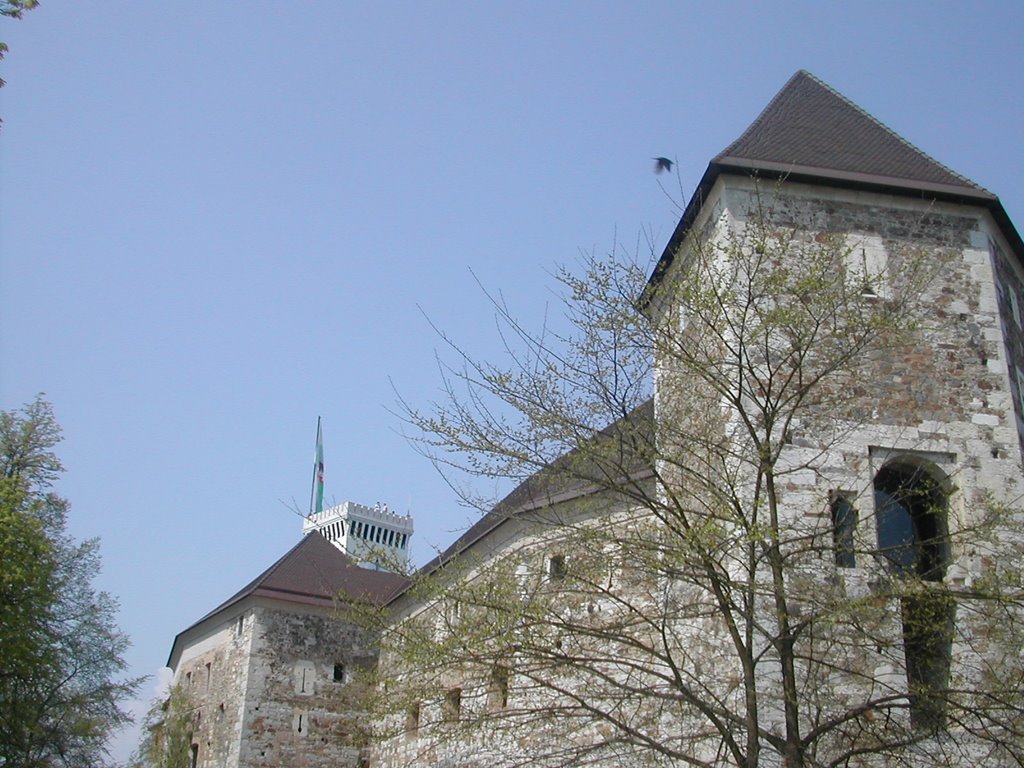
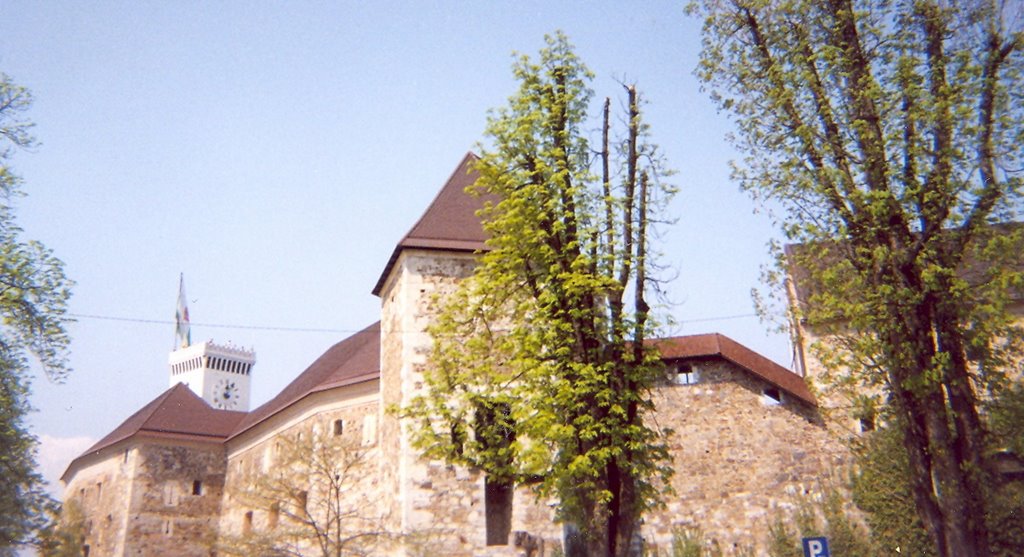
Ljubljana Castle. Two cameras, slightly different angles, looks like two different seasons - one shows a tree with the leaves all out, another shows a neighbor just budding. We were there in early May. Travel with a buddy.

Lubljana dominates the view of the capitol city, Ljubljana, as it should. Still, finding the way up is not simple. Go through a park drive, leave the car, and then walk. Detail to check out, next trip: What is the history of using angular towers instead of round? Which came first? The square tower in the background was built in the 1800's. The earliest beginnings of the castle area: 1100's. See www.ljubljana-calling.com/ENG/inCallingZnGrad.

The castle has a cafe, and reception halls - used for many cultural events. See www.virtualtourist.com/travel/Europe/Slovenia/Mestna_Obcina_Ljubljana/Ljubljana-688015/Things_To_Do-Ljubljana-Ljubljana_Castle-BR-1.
Wear good walking shoes - parking on the way up the hillside is limited, and the road hairpins.

Sunday, December 10, 2006

Links, posts

References to third-part sites here are in written form, not the direct quick-click link in the familiar blue underlining. This appears prudent, see www.bitlaw.com and other sites on the convoluted area of copyright, internet and the like. A loss. Writing out web addresses instead of linking defeats the speed-access, hop-around exhilaration, of the web. Surely somebody smart can work out reasonable copyright protections for the internet setting in a better way.

Posts: These are laid out in the itinerary order, not necessarily by actual date. This made more sense in a travel-site. A new post may appear at the beginning, but will probably be incorporated elsewhere later on.

Technorati Profile

Wednesday, December 06, 2006

People conflicts; Gypsies (Roma) - And Music

Gypsies. Beautiful music, background still misty. Here is some of the music: http://video.google.com/videoplay?docid=-6077876602430937809". This particular bit is Russian, but you can search for gypsy music and get many nationalities, and there are broad similarities.

The most beautiful, neat settings can foster deep-rooted prejudices, people against people, like anywhere. Here is a New York Times article, nytimesagency.com/preview/NTA2006112674803, that reports on one particular Slovenia Roma family forced out of home.

A simple search of news for "Slovenia gypsies" produces many more articles on the overall topic. We saw gypsies (known as Roma) mostly in Romania, and Croatia, but we were also looking for them more there. There is a wide variety of economic situations among them, as with any group, and some are in traditional costume, others blend.

Here is a site to remember: www.politicalgateway.com/news/read/47348. This site lets you click on the different countries for overviews on Roma and progress (or not) and learn about the history.

Also see our country-blog, Romania Road Ways.

Here is a site where you can scroll down to the music part - click, and enjoy. Go to www. worldmusic.nationalgeographic.com/worldmusic [the rest of the address would be /view/page.basic/genre/content.genre/roma__gypsy__music_778]. One of my favorits is this traditional Balkan singer - sounded very familiar after hearing radios and groups in pubs. Excellent.